Laser Therapy
|
|
Healing Arts Veterinary Center is proud to be one of a few clinics in Florida to offer Class IV high intensity laser therapy. Lasers are not new. Class III therapy lasers were first approved by the FDA in the United States in 2002. Class IV lasers received FDA approval in the United States in 2005, but have been used in Europe for much longer. Acceptance has been rapid in human rehabilitation and is slowly on the rise in veterinary medicine.
Class IV laser therapy is the use of an intense beam of laser light directed into tissues to reduce pain, increase blood flow, decrease inflammation and promote healing. Unlike previously available Class III cold laser units (power of 500 milliwatts or less), our new laser is capable of producing 12,000 milliwatts (24 times more powerful). This allows us to provide therapy to deep tissues around the hips, shoulders and spine in much less time. No matter what kind of pet you have, large or small, exotic or domestic, laser therapy can be part or the solution to help ease your pet's pain. Safe and effective, this powerful modality provides increased mobility, increased wound healing, bactericidal activity and post surgery rehabilitation.
Visit our page on YouTube to see some of our rehabilitation and laser patients; including Zoe, a quadriplegic dog that was able to walk again after undergoing laser and physical therapy.
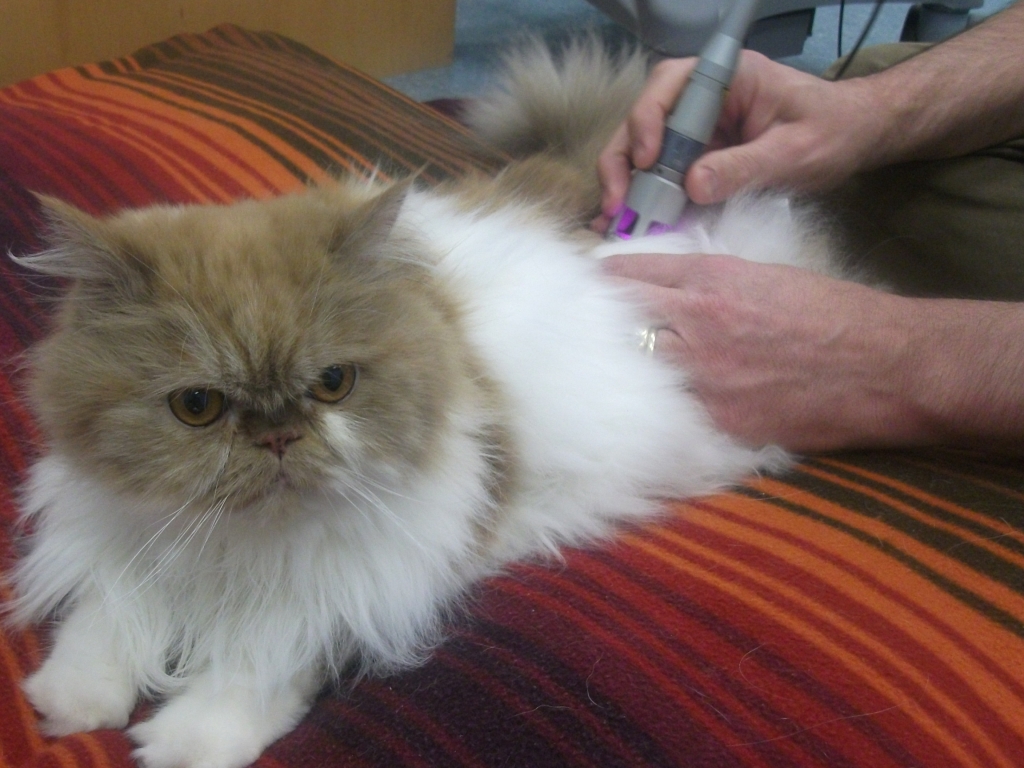
Laser Therapy is also a great option for cats! Cats are very sensitive to medication and do not have the same options as dogs when it comes to pain relievers and anti-inflammatory medications. Cats that have a joint injury or arthritic pain in their backs can be successfully treated with Laser Therapy.
|
What is laser therapy?
Photobiomodulation and Photobiostimulation are the scientific terms for Laser's effect on tissue. Deep-penetrating photons from the laser influence cell chemistry in a variety of beneficial ways. In addition, the infrared wavelengths create a warm sensation in your pet's body at the precise location requiring treatment. Treatment time, power and laser pulse frequency are based on your pet's individual condition and body size.
What conditions can be treated?
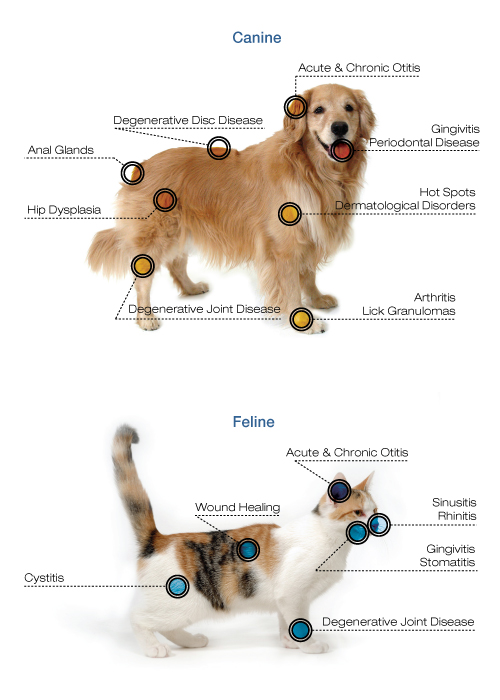
- Ulcerations and open wounds
- Muscle, ligament and tendon injuries
- Sprains and strains
- Pododermatitis
- Post-surgical and soft tissue trauma
- Back pain
- Neuromuscular disease
- Acute and Chronic Ear Infections
- Gingivitis
- Hot Spots
- Arthritis
- Lick Granulomas
- Degenerative Disc Disease
- Degenerative Joint Disease
- Hip Dysplasia
- Anal Gland Infections
What to expect...
No sedation is required and the experience is usually pleasant and comforting to the animal. Pets do not need to have their hair clipped either.
Although improvement is often seen after the first visit, most patients require several treatments (3 to 8) for greatest benefit. For most conditions, we recommend a multi-visit treatment plan. Treatments vary in length, but most sites require 2 to 8 minutes. A majority of patients exhibit greater comfort and mobility within 12 to 24 hours after a laser treatment.
Class IV laser therapy treatments are cumulative in nature. Therefore each additional treatment continues to improve your pet's condition. The length and frequency of treatments varies with your pet's condition. A sample treatment schedule is as follows
- Every other day for one week (3 total)
- Twice the second week (2 total)
- Once the third week (1 total)
- Boosters as needed
We will recommend a treatment plan specific to your pet's condition after a consultation and physical examination. The cost of most treatments is $45 to $70 per session.
|
Where is it beneficial?
Clinical studies and trials of laser therapy technology indicate the following beneficial effects of laser light therapy on tissues and cells:
- Accelerated Tissue Repair and Cell Growth. Photons of light from lasers penetrate deeply into tissue and accelerate cellular reproduction and growth. The laser light increases the energy available to the cell so that the cell can take on nutrients faster and get rid of waste products. As a result of exposure to laser light, the cells of tendons, ligaments and muscles are repaired faster.
- Faster Wound Healing. Laser light stimulates fibroblast development [fibroblasts are the building blocks of collagen, which is predominant in wound healing] in damaged tissue. Collagen is the essential protein required to replace old tissue or to repair tissue injuries. As a result, laser therapy is effective on open wounds and burns.
- Reduced Fibrous Tissue Formation. Laser therapy reduces the formation of scar tissue following tissue damage from cuts, scratches, burns or surgery.
- Anti-Inflammation. Laser light therapy has an anti-edemic effect as it causes vasodilation, but also because it activates the lymphatic drainage system [drains swollen areas]. As a result, there is a reduction in swelling caused by bruising or inflammation.
- Anti-Pain [Analgesic]. Laser therapy has a high beneficial effect on nerve cells which block pain transmitted by these cells to the brain and which decreases nerve sensitivity. Also, due to less inflammation, there is less edema and less pain. Another pain blocking mechanism involves the production of high levels of pain killing chemicals such as endorphins from the brain.
- Improved Vascular Activity. Laser light will significantly increase the formation of new capillaries in damaged tissue that speeds up the healing process, closes wounds quickly and reduces scar tissue. Additional benefits include acceleration of angiogenesis, which causes temporary vasodilatation, an increase in the diameter of blood vessels.
- Increased Metabolic Activity. Laser therapy creates higher outputs of specific enzymes, greater oxygen and food particle loads for blood cells.
- Improved Nerve Function. Slow recovery of nerve functions in damaged tissue can result in numbness and impaired limbs. Laser light will speed up the process of nerve cell reconnection and increase the amplitude of action potentials to optimize muscle action.
- Immunoregulation. Laser light has a direct effect on immunity status by stimulation of immunoglobulins and lymphocytes. Laser therapy is absorbed by chromophones that react to laser light. The enzyme flavomononucleotide is activated and starts the production of ATP [adenosine-tri-phosphate], which is the major carrier of cell energy and the energy source for all chemical reactions in the cells.
- Trigger Points and Acupuncture Points. Laser therapy stimulates muscle trigger points and acupuncture points on a non-invasive basis providing musculoskeletal pain relief.
|
|


 Processing ....